
Gas leaks involving combustible gases can create serious safety risks in industrial facilities, commercial buildings, and other environments where flammable gases are present. A fixed gas detector provides continuous monitoring and helps identify potential leaks before they become dangerous.
In this article, we will walk through the installation, wiring connection, internal structure, and alarm testing process of GasDog wall-mounted fixed flammable gas detector.
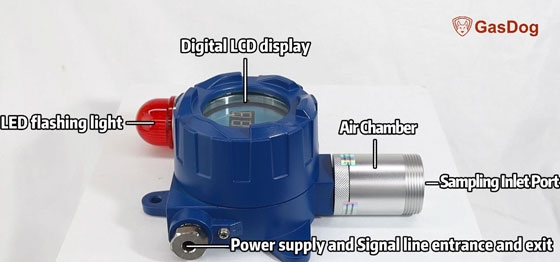
Fixed Gas Detector Structure
This fixed combustible gas detector is designed for continuous gas monitoring and alarm protection.
The main components include:
- Power and signal wiring inlet for electrical connections
- Digital LCD display for real-time gas concentration readings
- LED flashing indicator and built-in siren alarm
- Gas sampling inlet port
- Detection chamber
- Aluminum alloy housing protecting the internal electronic components
The rugged metal enclosure provides mechanical protection, while the IP65 protection rating allows the fixed detector to operate reliably in demanding environments. Besides the wall-mounted version, GasDog also provides different installation options, including pipeline-mounted and ventilation-mounted models for different application requirements.
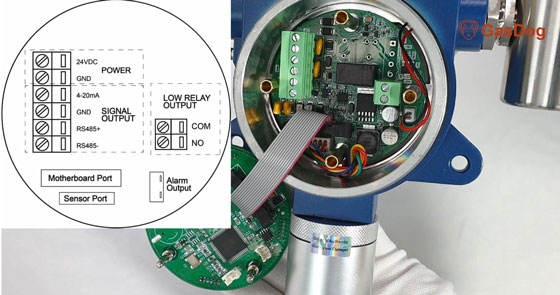
Internal Circuit and Terminal Configuration
To better understand the wiring process, the detector housing can be opened to check the internal circuit structure. After removing the metal cover and LCD module, the internal PCB becomes visible. The fixed gas detector operates with a 24V DC power supply and supports multiple signal outputs, including 4-20mA analog output, RS485 communication output, and relay alarm output. The internal circuit also includes a main control board connection, a sensor connection port, and an alarm output terminal.
Wiring Connection Process
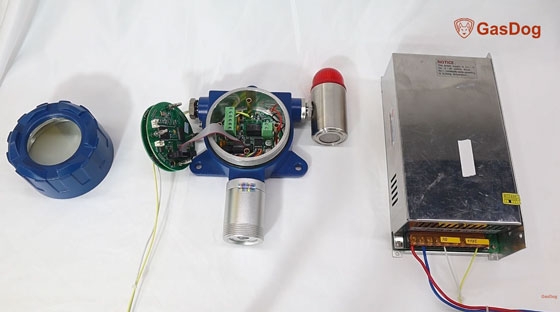
After confirming the terminal arrangement, the gas detector can be connected to the power supply. For this demonstration, a 24V DC power supply is used.
The wiring steps are:
- Connect the positive power wire to the power input terminal.
- Connect the negative wire to the ground terminal.
- Check that all wiring connections are secure.
- Install the LCD module and close the metal housing.
Once the connection is completed, the gas detector is ready for testing.
Fixed Gas Detector Alarm Testing
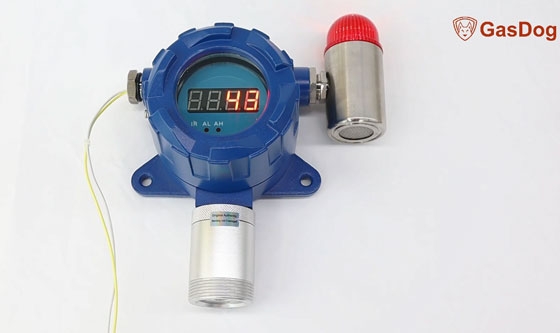
To verify the detection performance, a butane gas source is introduced near the sampling inlet. During the test, the gas concentration starts increasing as the detector gets closer to the gas source. The LCD display shows a rising concentration value. When the concentration reaches the alarm threshold, the LED indicator flashes and the built-in siren activates. After the gas source is removed, the detected concentration gradually decreases. Once the concentration falls below the alarm level, the alarm automatically stops. The remote control can also be used to manually reset the alarm when required.
The test demonstrates that the detector can quickly respond to combustible gas leaks and provide both visual and audible warnings.
Why Choose Our Flammable Gas Detector?
This fixed gas detector uses a diffusion-type detection method with a gas-sensitive sensor that provides a fast response to combustible gases. The built-in sensor uses catalytic combustion technology, combined with an anti-interference design to improve detection stability and reduce the impact of environmental factors.
It features fast response to gas leaks, reliable alarm performance, low energy consumption, continuous monitoring capability, and strong resistance to interference. These features help ensure stable and accurate gas detection in different working environments. They are widely used in areas that require continuous gas monitoring, including gas storage rooms, chemical plants, manufacturing facilities, boiler rooms, laboratories, commercial kitchens, and other industrial areas. By providing early warnings of gas leaks, these detectors help improve safety and reduce potential risks.
Watch the complete video: Wall-mount Fixed Flammable Gas Detector Hookup & Testing
Conclusion
A gas detector is an important part of a gas safety system. Proper installation, wiring, and testing ensure the device accurately detects gas leaks and activates alarms when needed. With a durable IP65-rated housing, multiple signal outputs, and fast detection response, GasDog combustible gas detector provides reliable protection for industrial and commercial environments where combustible gases may be present.


