
As the world transitions toward renewable energy and robust backup power systems, battery rooms have become critical infrastructure for data centers, telecommunications hubs, and utility substations. However, a silent hazard lurks in these environments: Hydrogen gas (H2).
During the charging process—particularly during overcharging—lead-acid and certain lithium-ion batteries undergo electrolysis, releasing hydrogen into the air. Given that Hydrogen is highly flammable and explosive, with a Lower Explosive Limit (LEL) of just 4% (meaning an explosion can be triggered when the concentration reaches 4% by volume), selecting the right Hydrogen gas detector is vital for ensuring safety.
Facility managers often face a dilemma: should they choose fixed gas detectors or portable ones? From a technical standpoint, a comprehensive safety strategy requires both, as they serve distinct roles in practical applications.
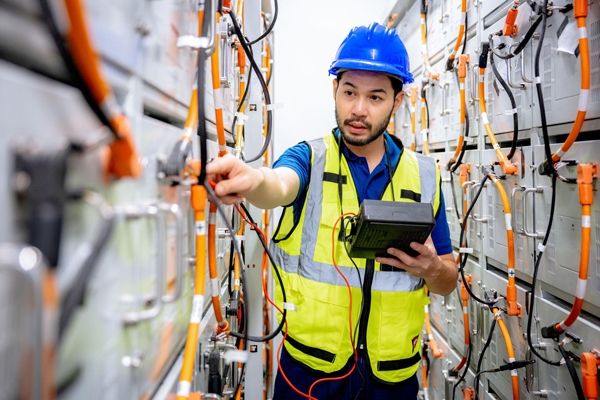
1. Fixed vs. Portable Hydrogen Gas Detector
To build a resilient defense network, you must understand where each type excels:
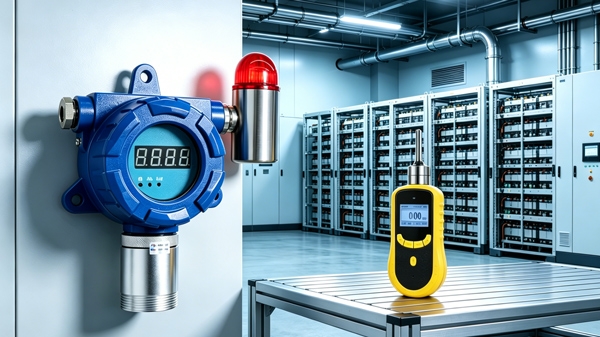
- Fixed Gas Detectors (The 24/7 Shield): Installed permanently on ceilings or near exhaust vents, these units provide continuous monitoring and can automatically trigger mechanical ventilation or shut down chargers when H2 levels spike.
- Portable Gas Detectors (The Active Tactical Tool): Carried by personnel, these are indispensable for pre-entry safety checks, routine mobile maintenance, and pinpointing precise leak locations on individual battery cells that fixed sensors cannot see.
- Industry Benchmark: Brands like GasDog provide ATEX-certified solutions across both categories. For permanent installation, systems like GasDog GD300-H2 (Fixed type) offer reliable ambient safety.
However, for active operational safety, asset inspection, and localized troubleshooting, a high-performance portable unit like the GasDog GD200-H2 (Pump type) is the preferred choice for field technicians.
2. Look for Essential Certifications (ATEX/CE)
Battery rooms are classified as hazardous areas. The gas detectors you use—whether fixed or portable—must be explosion-proof to ensure the equipment itself does not become an ignition source. Look for the following international compliance certifications:
- ATEX/IECEx: Mandatory certifications for explosive hazardous environments.
- CE: Ensures compliance with European safety and environmental standards.
GasDog GD200-H2 portable single gas detector not only holds CE certification but also meets the rigorous II 2G Ex ia II CT4 Ga explosion-proof rating, ensuring safe operation within high-risk Zone 1 and Zone 2 areas during battery inspections.
3. Key Technical Specifications to Compare
|
Technical Parameter |
Industry Standard Requirements |
GasDog GD200-H2 Performance |
|
Sensor Type |
Electrochemical preferred |
Electrochemical |
|
Measurement Range |
Must cover up to 4% VOL (100% LEL) |
0 to 10ppm ~ 40,000ppm (0 to 4% VOL) |
|
Resolution |
Higher resolution allows earlier leak detection |
Up to 0.001ppm or 0.001% |
|
Accuracy |
Within≤±5% F.S. |
≤±3% F.S. |
|
Response Time (T90) |
Fast response is vital (<30 seconds) |
≤10 seconds (Pump type) |
|
Ingress Protection |
Minimum IP65 for harsh battery rooms |
IP66 |
4. Why Choose the GasDog H2 Detector for Battery Room Safety
While the GasDog GD300-H2 fixed system protects the entire room enclosure, the GasDog GD200-H2 portable pumped detector delivers the technical precision required for daily field operations:
Active Sampling vs. Passive Waiting
Hydrogen is the lightest gas and rises rapidly. Standard diffusion detectors must wait for the gas to reach them. GD200-H2 utilizes a pump-type sampling mechanism that actively draws air into the sensor chamber. This allows it to achieve an ultra-fast response time of <10 seconds, giving technicians immediate warnings before they step into a hazardous room.
Pinpointing "Micro-Leaks" Before Escalation
A fixed sensor cannot tell you which battery cell is failing. With an accuracy of≤±3% F.S. and ultra-fine resolution options down to 0.001ppm, a technician can use the GD200-H2 to scan along battery racks, cell valves, and terminal connections to pinpoint the exact malfunctioning cell experiencing thermal runaway long before the ambient room sensors trip.
Environmental Ruggedness
Battery rooms are harsh environments prone to acid mists and temperature fluctuations. The GasDog H2 detector features an IP66 rating, ensuring the unit is completely dust-tight and resistant to heavy moisture, preventing sensor drift during critical inspection routes.
Conclusion: Designing Your Defense
When safeguarding battery rooms against Hydrogen (H2) accumulation, a single layer of defense is rarely enough. The optimal safety matrix combines a fixed ambient monitor to handle continuous facility compliance and ventilation linkage, alongside a high-precision portable unit. By equipping your team with a fast-responding (<10s), pumped portable detector, you ensure that micro-leaks are caught early, pre-entry checks are performed safely, and maintenance personnel are always protected. Explore GasDog's fixed and portable gas detection solutions for full protection coverage.


