
GasDog combustible gas detector is an important safety tool for identifying potentially dangerous gas concentrations before they become a serious hazard. But knowing how to use a combustible gas detector correctly is just as important as choosing the right detector.
This practical guide explains how to operate a 4-in-1 gas detector for CO, H2S, O2, and LEL, including startup, sensor warm-up, alarm testing, pumped detection, diffusion detection, shutdown, and charging.
If you are using a portable gas detector for workplace safety, confined-space monitoring, maintenance, or combustible gas leak detection, the following steps will help you understand the device's basic operation.
Watch the complete video: How to Use a Combustible Gas Detector
What Does a 4-in-1 Gas Detector Detect?
This portable 4-in-1 gas detector monitors CO, H2S, O2, and LEL in a single device. CO and H2S are toxic gases; O2 measures Oxygen concentration, while the LEL channel is used to monitor combustible gas concentrations.
For example, a Butane test can be used to demonstrate the detector's response to a combustible gas through the LEL channel. The actual response to specific gases depends on the sensor type, calibration, and detector specifications.
How to Operate a Combustible Gas Detector: Controls, Detection Modes, and Charging
1. Understanding the Controls
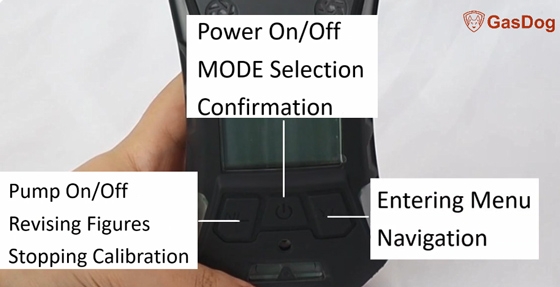
Let's start with the controls. The gas detector has three push buttons, providing a range of functions, including Power On/Off, Mode Selection, Confirmation, Pump On/Off, revising figures, stopping the calibration countdown, entering the menu, and navigation. Now, let's get started with the operation.
2. Powering On the Detector
- To turn on the device, press and hold the center power button for 3 seconds.
- During startup, the LED alarm lights will flash and the beeper will sound. The screen will then display "Welcome."
- The gas detector will enter the self-test mode, and the startup sequence will proceed automatically.
- Following the self-test is a warm-up process, which takes about 1 minute. This allows the sensors to become fully activated.
- After the countdown is complete, the detector will automatically enter detection mode, indicating that the startup process is complete.
3. Understanding the Display
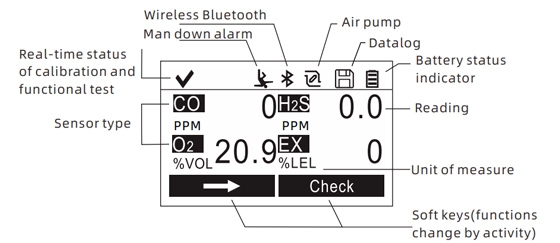
During standard operation, the LCD provides the following information in three sections. At the top of the screen, you will see several function icons. In the middle section, the concentration readings of four gas types are displayed simultaneously. The measurement unit is shown underneath each gas type. In fresh air, Oxygen generally reads 20.9%, while the other gas readings should be zero.
At the bottom of the screen, there is a return arrow and another function icon for checking the alarm functions. Press the [Y/+] button, and the detector will automatically test all of its alarm indicators to make sure they are working properly.
4. Pump and Diffusion Detection Modes
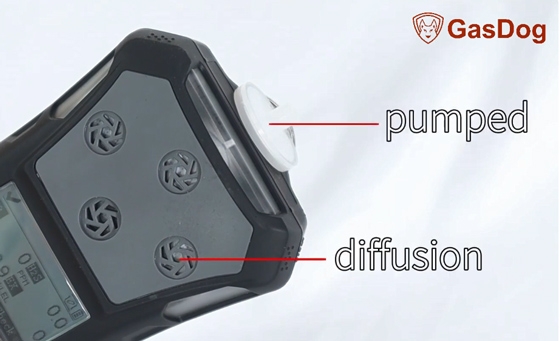
This gas detector supports both pumped and diffusion gas detection modes. The pump inlet is located on the top of the device and is equipped with a filter. Always make sure the filter opening is clean and free of dust. Let's first test the pump mode.
Release a small amount of butane from a lighter and allow it to flow into the filter. As the gas enters the detector, the increasing and decreasing gas concentrations will be shown on the display under O2 and explosive gas. When any measurement exceeds or falls below its preset alarm value, the detector will simultaneously activate the vibration, audible, and flashing visual alarms. The corresponding gas type will also flash on the display when its reading falls outside the normal range. As you can see, the detector responds quickly and works effectively in pump mode.
5. Testing Diffusion Mode
Now let's try the diffusion mode with some butane. As you can see, the detector still responds to the gas, although the sensitivity for explosive gas detection is not as good as in pump mode.
When the measured values exceed the preset alarm limits, the detector will immediately vibrate, flash, and produce an audible alarm to alert the user. Generally, this model operates in pump mode. However, if the pump fails, you can switch to diffusion mode for gas detection. This dual-mode design provides greater flexibility during measurement and offers more reliable protection.
6. Powering Off the Detector
When gas detection is complete, simply press and hold the center On/Off button for 5 seconds to turn off the detector. When the device is powered off, you can also briefly check the following information by pressing and holding the [N/-] button for 3 seconds.
7. Charging the Detector
When the battery is low, it is time to recharge the detector. The charging method is slightly different because this model comes with a special charging kit, as mentioned in the unboxing section.
First, remove the small rubber pad on the device. You will find four charging contacts underneath, which connect with the contacts on the charging stand. Place the detector on the charging stand, then connect the power adapter to a power source. During charging, the red LED indicator will remain on. Once the detector is fully charged, the indicator will turn green.
FAQs About Combustible Gas Detectors
Q1: Can an LEL detector detect Butane?
A1: An LEL sensor can respond to combustible gases such as butane, depending on the sensor type, calibration, and detector specifications. A butane lighter can be used as a demonstration of combustible gas response, but professional testing should use an appropriate certified test gas.
Q2: What is the difference between pump mode and diffusion mode?
A2: Pump mode actively draws a gas sample into the detector, while diffusion mode relies on gas naturally reaching the sensor. Pumped sampling can be advantageous when gas needs to be sampled from a specific location.
Q3: Can I use a combustible gas detector without the pump?
A3: If the detector supports diffusion operation, it may continue to monitor gases in diffusion mode. However, diffusion mode should not automatically be considered an equivalent replacement for pumped sampling in every application.
Conclusion
GasDog combustible gas detector is most effective when users understand both the instrument and the conditions in which it is being used. This 4-in-1 gas detector combines CO, H2S, O2, and LEL monitoring in a portable instrument, while its pump and diffusion operating modes provide additional flexibility for different gas detection tasks.
From startup and warm-up to alarm testing, combustible gas testing, shutdown, and charging, following the correct operating procedure helps users get the most reliable performance from their gas detection equipment. If you are looking for a portable solution for CO, H2S, O2, and combustible gas/LEL monitoring, explore the available GasDog combustible gas detectors and choose the configuration that matches your application.


