
In modern homes and industrial production, natural gas, as a clean and efficient energy source, has long been deeply integrated into our daily lives. From gas stoves in the kitchen to wall-hung boilers in winter, and from urban power supply to industrial production, natural gas is everywhere. However, many people’s understanding of natural gas is limited to "cooking and heating". They do not know what natural gas is, what its composition is, where it comes from, and the key safety precautions when using it. This article systematically introduces natural gas and focuses on home gas safety measures to help everyone use it more safely and scientifically.
1. What Is Natural Gas? (Formation, Types & Composition)
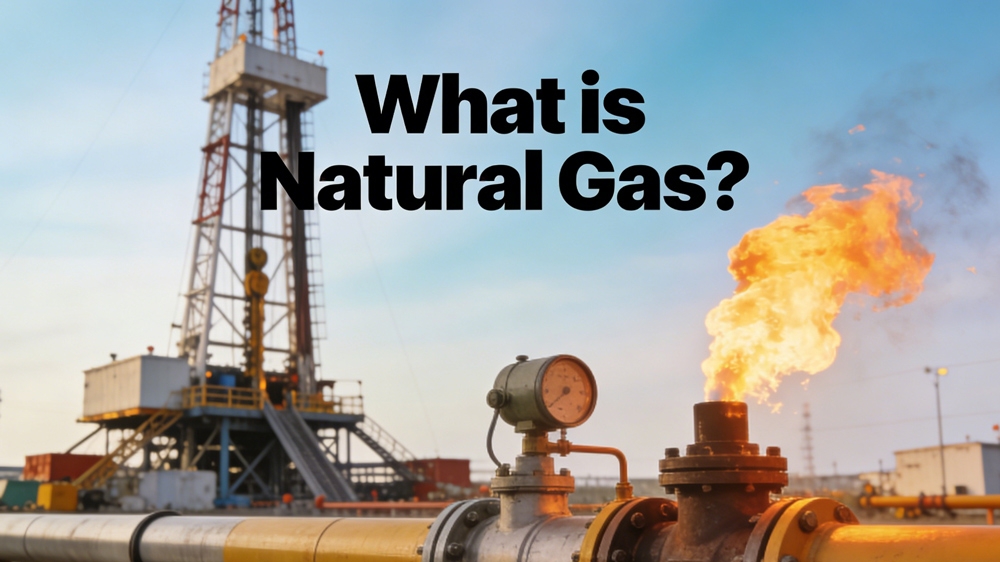
Natural gas is a flammable mixture of hydrocarbons found in underground rock formations and is an important type of fossil energy. Its formation and existence have clear characteristics, which can be divided into two points:
- Formation process: It requires a long geological evolution. Ancient animal and plant remains were buried layer by layer, and after hundreds of millions of years of transformation under the long-term action of high temperature, high pressure and microorganisms, natural gas that can be burned and used was finally formed.
- Existence form: It is relatively diverse. It is usually produced along with oil extraction (called associated petroleum gas), and can also exist independently in special gas fields, coal seams or shale formations. Natural gas from different sources has slightly different compositions and purities, but their core uses are the same.
No matter what source of natural gas it is, after extraction, purification and other processes, it will be widely used in various fields of production and life as a clean heat source and energy raw material.
There are mainly four types of natural gas we come into contact with in daily life. They can be simply distinguished according to usage scenarios to help you better understand natural gas. The most common one is gas field gas, which is pure natural gas with the highest Methane content (up to more than 95%). It is also the cleanest and most suitable type of natural gas for home use. Associated petroleum gas is produced along with crude oil, and can be widely used in homes and industries after purification to remove impurities. Condensate gas field gas contains a small amount of light oil, which is more suitable for heating, power generation and other scenarios in industrial production. Coalbed Methane is extracted from coal seams, and can also be used as a qualified natural gas resource after desulfurization, purification and other processes. The natural gas pipeline entering our homes is mostly gas field gas that has undergone strict purification treatment. It not only has few impurities and stable combustion, but also has higher safety. This is the core reason why natural gas can widely enter thousands of households and become the mainstream energy for families.
In terms of composition, natural gas is not a single gas, but a mixed gas with Methane (CH4) as the main component. Its composition is clear, and its core characteristics are as follows:
- Core component: Methaneaccounts for 85%–98%. It is the core of natural gas combustion and heat supply, directly determining the calorific value and use efficiency of natural gas, and it is also the key to efficient heat supply of natural gas.
- Secondary components: It contains a small amount of hydrocarbons such as Ethane, Propane and Butane, which can further improve the calorific value of natural gas and make combustion more efficient. It also contains trace non-flammable components such as Nitrogen, Carbon Dioxide and water vapor, which do not affect the use safety and combustion efficiency.
- Safety treatment: Natural gas itself is colorless, odorless and non-toxic. To facilitate detection when leaking, gas companies will artificially add an odorant similar to the smell of rotten eggs, which is an important basis for judging natural gas leakage in daily life.
2. Natural Gas Characteristics & Application Scenarios
The core characteristics of natural gas determine its usage scenarios and safety precautions, and they are also the key to making it a mainstream clean energy source. There are mainly three major characteristics:
- Good safety: Natural gas is lighter than air. Once it leaks, it will naturally diffuse upward and is not easy to accumulate on the ground, so it has better basic safety than other gases.
- Clean and efficient: It has a high calorific value and clean combustion. The combustion products are mainly carbon dioxide and water, which produce almost no pollutants such as dust and sulfides. It conforms to the "dual carbon" concept and is an environmentally friendly form of fossil energy.
- Flammable and explosive: When the concentration of natural gas in the air reaches 5%–15%, it may cause combustion or even explosion when it encounters open flames, static electricity or switch sparks. This is a key risk that needs to be focused on during use.
It is these characteristics that make natural gas suitable for wide application and also require us to do a good job in safety protection. This is also the core reason for installing natural gas alarms.
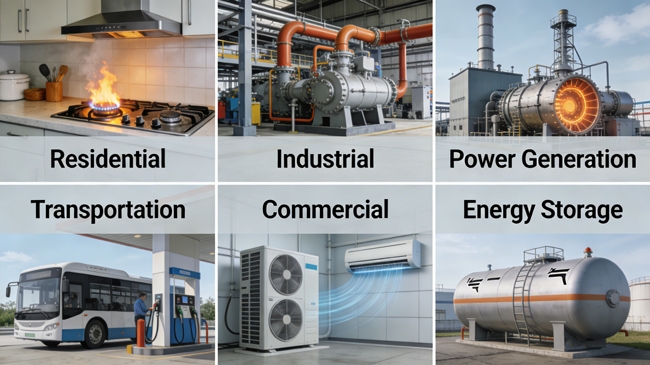
Natural gas has a wide range of uses, far more than home cooking and hot water supply. It covers many fields such as life, industry, energy and transportation, which can be specifically divided into five scenarios:
- Home life: Used for cooking, domestic hot water supply, winter heating and wall-hung boiler heating to create a comfortable environment for families.
- Urban power supply: It has high power generation efficiency and low emissions. It is an important supplement to stabilize urban power supply and alleviate the tension during peak power consumption.
- Industrial production: As a heat source and raw material for steelmaking, ceramics, glass, textile drying and other industries, it helps industries achieve efficient and environmentally friendly production.
- Chemical industry: As a basic raw material, it is used to produce chemical fertilizers, plastics, methanol, hydrogen and other products, driving the upgrading of the chemical industry.
- Transportation: CNG and LNG natural gas vehicles, buses and heavy trucks are popular. They are both environmentally friendly and economical, reducing carbon emissions in the transportation field.
With the advancement of relevant policies, the proportion of natural gas in the energy structure continues to increase, making it a core choice for the transition from fossil energy to new energy, and its application scenarios will be further expanded in the future.
3. Natural Gas Leakage Causes & Home Safety Precautions
Although natural gas is convenient, clean and efficient, the core premise of using natural gas is to do a good job in safety protection. The biggest hidden danger of natural gas safety is natural gas leakage. Combined with common scenarios of families and small shops, the main reasons for natural gas leakage are as follows, which you can focus on:
- Aging, cracking or falling off of the hose connecting the gas stove and water heater. This is the most common hidden danger of natural gas leakage in families. Especially rubber hoses, which are easy to age and corrosion after long-term use. It is recommended to replace them every 1-2 years.
- Aging and loosening of the gas valve and interface seal, leading to slow leakage of natural gas. This kind of leakage is highly concealed and not easy to detect. Long-term accumulation can easily reach the explosion concentration, with an extremely high risk.
- Gas stoves and water heaters are used beyond their service life. The equipment parts are worn and the sealing performance is reduced, which cannot effectively isolate natural gas. Leakage is easy to occur during use, and the failure probability will be greatly increased.
- During the decoration process, the gas pipeline and valve are accidentally damaged and not found and repaired in time. Continuous leakage will occur in subsequent use, becoming a long-term safety hazard.
- Abnormal gas pressure during gas cut-off and resupply leads to leakage at pipeline interfaces and valves. Failure to check after resupply is likely to cause danger.
If these natural gas leakage hazards are not handled in time, they may cause suffocation in mild cases, and fire or explosion in severe cases, resulting in irreparable personal and property losses. Especially when sleeping at night or when no one is at home, the risk is more difficult to control. Therefore, it is urgent to do a good job in natural gas safety protection.
In the daily use of natural gas, we can do basic manual protection to reduce the risk of leakage. However, manual protection has limitations and cannot achieve 24-hour all-round monitoring:
- Regular inspection: Check the gas hose, valve and interface every month. Apply soapy water to the connection and observe if there are bubbles to check for leakage hazards. Prioritize the use of metal corrugated pipes instead of aging rubber hoses.
- Standard use: Do not leave the gas unattended when in use. Keep an eye on it during cooking and boiling water. Turn off the main gas valve in time after use, and develop the habit of "turning off the valve when leaving" to eliminate the hidden danger of "leaving the valve open for a long time".
- Keep ventilation: Must open windows when using gas to keep the gas-using areas, such as kitchens and bathrooms, well ventilated, so as to avoid the accumulation of natural gas after leakage.
- Prohibit illegal operations: It is strictly prohibited to privately modify or wrap gas pipelines and valves. If modification is needed, you must contact the professional gas company staff to operate. Do not install gas equipment in closed spaces.
4. GasDog Natural Gas Alarm: Home Gas Leak Protection Solution
Although manual protection can reduce some risks, it cannot deal with scenarios such as unattended and night leakage. At this time, a professional natural gas alarm is needed to protect home gas safety. GasDog natural gas alarm is a cost-effective choice suitable for families, rental houses and small shops, which can perfectly make up for the shortcomings of manual protection.
GasDog natural gas alarm has become the first choice for natural gas safety protection because of its outstanding core advantages, which are suitable for various gas-using scenarios:
- High-sensitivity monitoring: Equipped with a professional Methanesensor, it can accurately identify natural gas leakage, eliminate false alarms and missed alarms, and quickly capture low-concentration natural gas for early warning.
- 24-hour uninterrupted protection: No manual operation is required. It can work immediately after being plugged in. It can continuously monitor the concentration of natural gas whether you are sleeping, going out or working, providing all-round protection against hidden dangers.
- Sound and light dual alarm: When the natural gas concentration exceeds the standard, it will immediately emit a high-decibel alarm, accompanied by flashing indicator lights, which can clearly remind you even at night and wake up your family to deal with it in time.
- Easy installation: Plug and play, no complicated wiring required. It is suitable for various installation positions such as kitchens and balconies, and can be easily installed by both renters and homeowners.
- Safety upgrade: Some models can be linked with gas solenoid valves, which automatically cut off the gas source when alarming, blocking natural gas leakage from the source and minimizing risks.
| Item |  |
 |
 |
| SKU | GD1000-GS91 | GD1000-C30W | GD1000-GC01 |
| Gas | LPG & Natural Gas | LPG & Natural Gas | CO & Natural Gas |
| Alarm | ✔ | ✔ | ✔ |
| WiFi | ✔ | ✔ | ✖ |
| T & RH | ✔ | ✖ | ✖ |
| Display | ✔ | ✔ | ✔ |
For every family, the safe use of natural gas is crucial. GasDog natural gas alarm, with its low cost and high reliability, has become an "essential artifact" to protect natural gas safety. Whether it is new house decoration, old community renovation or rental living, installing a GasDog natural gas alarm can make gas use more at ease and effectively avoid various risks caused by natural gas leakage.
Finally, we remind you that only by correctly using natural gas and natural gas alarms can we maximize the protection effect. Please pay attention to the following points:
- Alarm installation position: It should be installed above the kitchen, within 30cm from the ceiling, away from direct smoke and steam blowing. Do not block or wrap the probe to avoid affecting the monitoring accuracy.
- Regular maintenance: Press the test button of the alarm every month to confirm that the equipment is working normally. Wipe the probe regularly to remove dust and oil stains to ensure monitoring sensitivity.
- Alarm emergency handling: Once the alarm sounds, immediately stop using natural gas, open windows for ventilation, turn off the main gas valve, strictly prohibit touching open flames and electrical switches, and then contact the gas company for maintenance in a safe outdoor area.
In summary, natural gas, as a clean and efficient energy source, has become an indispensable part of our lives and production. Understanding the sources, composition, characteristics, and uses of natural gas can help us use it better. Paying attention to home gas safety, taking basic precautions, and installing GasDog home gas alarms can help us avoid the risk of leaks.


