
Methane (CH4) is one of the most widely used energy gases in both industrial operations and residential households. It powers heating systems, fuels industrial processes, and supports essential infrastructure. Yet despite its usefulness, Methane also presents a silent safety challenge—leaks are often invisible, odorless at low concentrations, and capable of escalating quickly if not detected early.
Effective Methane gas detection is not just about installing a sensor. It is about building a reliable safety layer that works continuously in the background, adapts to different environments, and delivers clear action when it matters most.
This is where GasDog gas detection solutions are designed to make a difference—bridging industrial precision and home simplicity in one safety ecosystem.
Why Methane Detection Requires a System, Not a Single Device
One of the most common misconceptions in gas safety is assuming that a single detector can solve all risks. In reality, CH4 behaves differently depending on pressure, airflow, and environmental structure. This means detection must be strategic rather than isolated.
In practical applications, gas leaks rarely occur in obvious, open spaces. Instead, they often develop in hidden or semi-enclosed areas such as:
- Pipeline junctions and valve systems in industrial plants
- Boiler rooms, storage zones, or compressor stations
- Kitchens, utility rooms, and gas appliance connections in homes
Because of this variability, an effective detection approach must combine continuous monitoring, targeted inspection, and real-time alerting. GasDog designs its Methane detection systems with this layered safety logic, ensuring coverage from early warning to precise identification.
Industrial CH4 Safety: From Early Warning to Precise Leak Location
In industrial environments, Methane safety is not only about preventing accidents—it is also about avoiding downtime, protecting equipment, and maintaining operational continuity. A small undetected leak can escalate into production disruption or safety shutdowns. GasDog industrial CH4 detection systems are built around three key operational needs:
Continuous monitoring in critical zones
Fixed gas detectors are installed in high-risk areas where Methane accumulation is most likely. Devices such as the GD300-CH4 fixed gas detector and GD700-CH4 industrial fixed gas detector provide real-time monitoring, helping teams maintain visibility even in unattended environments.
Fast field verification during inspections
When alarms are triggered or maintenance is performed, technicians rely on portable tools like the Handheld Methane CH4 gas detector. This mobility allows workers to move through complex systems and quickly identify the exact source of leakage instead of relying on estimation.
Integrated safety workflow instead of isolated alerts
Rather than treating each detector as an independent alarm point, industrial systems benefit from a connected workflow—fixed monitoring identifies risk zones, while handheld detection confirms and localizes the issue. This combination significantly reduces response time and improves decision accuracy in real operational conditions.
Home Methane Detection: Protecting Everyday Living Spaces
In residential environments, Methane risk is often underestimated because gas systems are familiar and routine. However, natural gas used in homes is primarily composed of Methane, which means any leakage directly involves CH4 exposure risk.
Unlike industrial users, homeowners are not expected to interpret gas concentration levels. Therefore, home gas detection devices must prioritize clarity, automation, and immediate response. GasDog home Methane detection solutions are designed specifically for this environment, focusing on simple but reliable protection:
Smart monitoring for natural gas safety
Devices such as the GasDog GD1000-GS91CH4 leak detector and GD1000-C30W WiFi natural gas leak monitor continuously track gas presence and send instant notifications when abnormalities occur. This ensures users are informed even when away from home.
Clear alarm-based protection without technical complexity
Instead of requiring interpretation of gas readings, home detectors provide straightforward alerts through sound, light, and mobile notifications. This design ensures that anyone in the household can understand and respond quickly.
Multi-risk protection in compact environments
In addition to Methane, devices like the plug-in CO and explosive gas detector help cover multiple household gas risks in a single system, making protection more practical for everyday use.
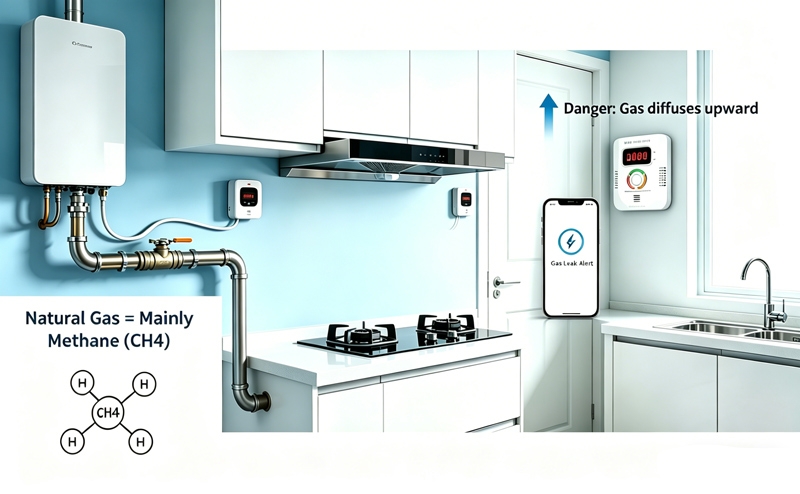
Why Placement and Installation Matter More Than Most Users Expect
Even the most advanced CH4 gas detector cannot perform effectively if it is installed incorrectly. Gas behavior is heavily influenced by density and airflow patterns, meaning positioning plays a critical role in detection speed. Methane is lighter than air, which means it naturally rises and accumulates near ceilings or upper spaces. This has direct implications for installation strategy:
- In industrial facilities, detectors should be placed near potential leak sources and above equipment zones where gas may accumulate
- In residential settings, installation near ceilings and close to gas appliances ensures faster detection response
GasDog devices are designed with flexible installation options, allowing users to adapt placement based on real environmental conditions rather than fixed assumptions.
Reducing False Alarms While Maintaining High Sensitivity
A major challenge in gas detection systems is balancing sensitivity with stability. If a detector is too sensitive, it may trigger unnecessary alarms due to environmental fluctuations. If it is not sensitive enough, it may miss early-stage leaks.
GasDog Methane detection systems address this balance through:
- Advanced sensor calibration for stable readings
- Environmental compensation to reduce interference from humidity or temperature changes
- Multi-layer detection logic in fixed systems to verify anomalies before triggering alerts
This approach ensures that alerts remain meaningful, helping users trust the system instead of ignoring it over time.
Maintenance and Long-Term Reliability of Gas Detection Systems
Gas detection is not a one-time installation—it is a continuous safety system that requires periodic maintenance. Over time, sensors naturally degrade, and environmental exposure can affect performance accuracy.
For industrial users, maintenance typically includes:
- Routine calibration checks
- Functional testing of alarm systems
- Replacement of sensors after service life ends
For home users, maintenance is simpler but still essential:
- Regular testing of alarm functionality
- Ensuring power supply stability (plug-in or battery-based systems)
- Following recommended replacement cycles
GasDog systems are designed to minimize maintenance complexity while maintaining long-term reliability, making ongoing safety easier to manage.
Building a Safer Environment Through Smarter Methane Detection
Methane CH4 gas detection is ultimately about preventing uncertainty. Whether in a large industrial facility or a small residential kitchen, the goal remains the same: identify risks early, respond quickly, and avoid escalation.
GasDog Methane detection solutions bring together industrial-grade monitoring and user-friendly home protection into a unified approach. Instead of treating safety as a reactive process, these systems support continuous awareness and proactive prevention.
In a world where gas systems are deeply integrated into daily life and industrial production, reliable Methane gas detection is no longer optional—it is a foundational layer of safety.


